
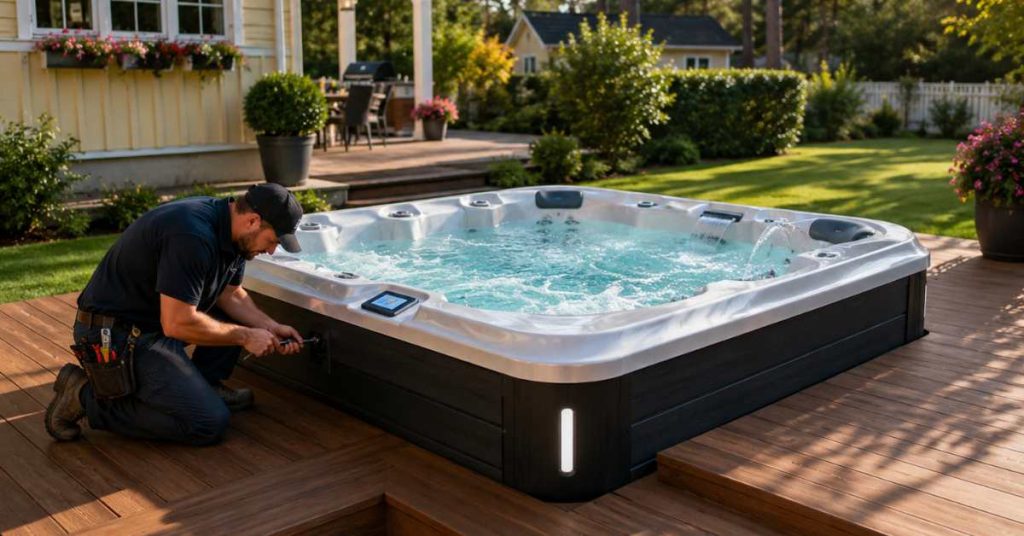
Buying a hot tub is exciting. It is easy to picture evening soaks, hydrotherapy after a long day, and a more relaxing backyard.
However, a smooth hot tub installation in Chandler starts before the spa arrives.
Homeowners need to think about the location, foundation, electrical service, delivery access, drainage, shade, water care, and long-term service access. Planning these details early can prevent delays and make installation day much easier.
Chandler’s climate adds a few local considerations as well. Strong sun, summer heat, desert dust, and hard water can all affect how you place, operate, and maintain your spa.
At Sunset Spas, we help homeowners compare premium hot tubs and swim spas based on backyard space, seating preferences, hydrotherapy needs, energy efficiency, maintenance, and budget. We also help customers understand the practical side of ownership, from installation planning to water care and accessories.
Here are 10 things Chandler homeowners should expect before their new hot tub arrives.
1. Choose the Hot Tub Before Finalizing the Site
Installation planning starts with the spa itself.
Different hot tubs have different:
- Dimensions
- Filled weights
- Electrical requirements
- Equipment-panel locations
- Cover-clearance needs
- Seating layouts
- Access requirements
That is why it is usually better to choose the model first and then finalize the installation area.
Think about how you will actually use the spa.
A couple may prefer a compact model with lounge seating and targeted hydrotherapy. A larger household may want open seating with more room for family and guests.
Consider:
- Number of regular users
- Available backyard space
- Preferred seating style
- Jet placement
- Energy efficiency
- Water-care features
- Accessibility
- Budget
- Lighting and entertainment features
The right spa should fit both your backyard and your lifestyle.
2. Pick a Location You Will Actually Use
Placement affects how often you enjoy the hot tub.
A spa positioned near the house or covered patio may feel more convenient than one placed at the far end of the yard.
Think about the walk from the house to the spa, especially at night or during cooler weather.
A good location should balance:
- Convenience
- Privacy
- Shade
- Drainage
- Service access
- Electrical planning
- Delivery access
- Backyard layout
Consider Privacy
Neighboring windows, streets, and nearby properties may affect how private the spa feels.
Possible solutions include:
- Privacy screens
- Pergolas
- Landscaping
- Walls
- Fencing
- Outdoor curtains
Think About Chandler Sun Exposure
Direct Arizona sunlight can make daytime use uncomfortable and increase UV exposure to the cover, cabinet, and controls.
Some shade may help.
However, do not create a tight enclosure that blocks ventilation or future service access.
3. Prepare a Strong, Level Foundation
A filled hot tub is extremely heavy.
The total load includes:
- The spa itself
- Hundreds of gallons of water
- The people using it
- Accessories
The foundation must support that weight without shifting or settling.
Common options include:
Concrete Pads
A properly built concrete pad provides a stable and durable base for many hot tubs.
Reinforced Existing Patios
An existing patio may be suitable if it is structurally sound and designed to handle the filled load.
Engineered Spa Bases
Some installations use purpose-built bases designed for hot tubs.
Whatever foundation you choose, it should be:
- Flat
- Stable
- Level
- Properly supported
- Sized for the spa
Avoid placing a full hot tub directly on loose soil, sand, gravel, or an unprepared surface unless the manufacturer specifically approves that installation method.
If there is any doubt about the structure, consult an appropriate qualified professional before delivery.
4. Plan the Electrical Work Early
Many full-size hot tubs require dedicated electrical service.
The exact requirements depend on the model, so do not assume every spa uses the same wiring.
Electrical planning may involve:
- A dedicated circuit
- GFCI protection
- Correct breaker sizing
- Proper wire gauge
- A disconnect
- Safe conduit routing
- Approved grounding and bonding
A qualified electrician should complete the installation according to the spa manufacturer’s specifications and applicable electrical requirements.
Planning this before delivery helps prevent the common problem of having the hot tub in place but being unable to start it.
Do not energize the spa until it is filled to the proper level and the startup procedure is complete.
5. Measure the Delivery Route
One of the most overlooked parts of hot tub installation is getting the spa from the street to the backyard.
Before delivery, measure the entire route.
Check:
- Gate width
- Side-yard width
- Fence openings
- Tight turns
- AC units
- Trees
- Roof overhangs
- Eaves
- Steps
- Retaining walls
- Slopes
- Overhead wires
- Patio structures
Hot tubs are often transported on their side using specialized carts or equipment.
That means both width and height matter.
If standard access is impossible, the installation may require a different delivery method.
Discuss unusual access conditions before delivery day so the team can plan appropriately.
6. Leave Room for Future Service
It is tempting to build landscaping, walls, decking, or cabinetry tightly around the spa.
That may look attractive, but it can make future service much harder.
Technicians may need access to:
- Pumps
- Heater
- Plumbing
- Electrical components
- Control systems
- Equipment panels
Do not permanently block those areas.
Also leave enough space for:
- Cover operation
- Cover lifter movement
- Steps
- Handrails
- Walking access
- Cleaning
- Drainage
Good installation planning considers not only how the spa looks on day one, but how it will be maintained years later.
7. Understand What Happens on Delivery Day
Once the site is ready, delivery usually focuses on moving and positioning the hot tub.
The team will typically:
- Move the spa to the prepared location.
- Position it correctly on the foundation.
- Confirm the orientation.
- Make sure important service areas remain accessible.
- Prepare it for the remaining setup process.
Before the spa is filled, check that the placement works with:
- Steps
- Cover opening
- Views
- Privacy
- Controls
- Equipment access
It is much easier to make small placement adjustments before the spa contains hundreds of gallons of water.
8. Fill the Hot Tub Correctly
After placement and electrical preparation, the spa must be filled according to the manufacturer’s instructions.
Some models recommend filling through the filter compartment. This can help reduce the chance of trapped air in the plumbing.
Do not turn on the heater or pumps before the water reaches the correct level.
Running equipment dry can cause damage.
Once the spa is full, the startup process may include:
- Restoring power
- Priming pumps
- Checking circulation
- Testing jets
- Setting temperature
- Confirming filtration
- Checking for leaks
Follow the instructions for the specific spa model rather than relying on a generic startup routine.
9. Balance Chandler’s Hard Water From the Beginning
Water care starts on day one.
Chandler water can contain significant mineral levels, so calcium management deserves attention from the first fill.
Test:
- pH
- Total alkalinity
- Sanitizer
- Calcium hardness
Balanced water helps protect:
- Heater components
- Plumbing
- Jets
- Filters
- Spa surfaces
Some homeowners use a hose pre-filter during filling to reduce certain minerals, sediment, or metals.
A scale-control product may also be appropriate depending on the water conditions and spa system.
The key is to establish balanced water early instead of waiting for white scale or cloudy water to appear.
Sunset Spas can help customers select water-care products suited to their spa and local water conditions.
10. Build Your Maintenance Routine Immediately
The easiest hot tub to maintain is one that receives regular care from the beginning.
A basic routine includes:
Two or Three Times Each Week
- Test the water
- Check sanitizer
- Check pH
- Check the water level
- Remove debris
Weekly
- Wipe the waterline
- Inspect the cover
- Check water clarity
- Confirm normal jet pressure
Every Few Weeks
- Rinse or clean the filters
- Review calcium hardness
- Clean the cover
- Inspect accessories
Every Three to Four Months
- Drain and refill as needed
- Clean the shell
- Inspect the filters
- Review equipment performance
Chandler’s heat and low humidity may increase evaporation, so check the water level more often during summer.
What Accessories Should You Plan for?
Accessories can make the spa much easier to use.
Spa Steps
Stable steps improve entry and exit.
Look for:
- Slip-resistant surfaces
- Correct height
- Stable construction
- Outdoor-rated materials
Cover Lifter
A cover lifter allows one person to open and close the cover more easily.
It also helps protect the cover from being dragged across concrete or dropped.
Handrail
A handrail may improve confidence when entering or leaving a wet spa.
Insulated Cover
A quality fitted cover helps:
- Reduce evaporation
- Retain heat
- Keep out dust
- Block leaves and insects
- Protect the water
Water-Care Supplies
Keep appropriate test supplies and maintenance products available from the first day.
Having everything ready makes it easier to develop good habits.
Should You Add Shade?
Shade can be especially useful in Chandler.
A pergola, covered patio, ramada, or shade sail may:
- Reduce direct sunlight
- Make daytime use more comfortable
- Protect some exterior components
- Improve the backyard atmosphere
However, any shade structure should leave adequate room for:
- Ventilation
- Delivery
- Cover movement
- Electrical access
- Maintenance
- Service
Do not assume the structure can be built later without affecting spa access.
Plan the hot tub and shade together when possible.
Think About Drainage Before Installation
Water will occasionally leave the spa.
That can happen during:
- Entering and exiting
- Cleaning
- Draining
- Filter maintenance
- Heavy splashing
The installation area should allow water to move away safely.
Avoid creating a low spot where water collects around the cabinet or equipment area.
Good drainage also helps keep the surrounding patio cleaner and reduces slip hazards.
How Long Does Hot Tub Installation Take?
The physical delivery and placement may happen relatively quickly.
However, the full installation timeline depends on how much preparation is already complete.
The project may include:
- Site planning
- Foundation construction
- Electrical work
- Delivery scheduling
- Placement
- Filling
- Startup
- Water balancing
If the foundation and electrical work are already finished, the process is much simpler.
Delays most often occur when homeowners discover access, power, or site-preparation problems at the last minute.
Common Installation Mistakes to Avoid
A little planning helps prevent expensive problems.
Avoid:
- Choosing the site before knowing the spa dimensions
- Ignoring filled weight
- Blocking equipment panels
- Forgetting cover clearance
- Waiting until delivery day to measure the gate
- Hiring unqualified electrical help
- Running equipment before filling
- Starting with unbalanced water
- Placing the spa where drainage is poor
- Building permanent structures too close to the cabinet
Most of these problems are easy to avoid when discussed before delivery.
How to Choose the Right Hot Tub for Chandler
Installation matters, but so does choosing the right spa.
Compare:
Seating
Do you prefer lounge seats or upright seating?
Hydrotherapy
Which areas of the body do you want the jets to target?
Size
How many people will use the spa regularly?
Energy Efficiency
Look at insulation, equipment, cover quality, and overall construction.
Water Care
Consider filtration and sanitation features that make maintenance easier.
Controls
Make sure the controls feel simple and easy to read.
Accessories
Plan for steps, cover lifters, handrails, and other everyday needs.
The best hot tub is the one that fits both the installation space and the people who will use it.
Why Chandler Homeowners Choose Sunset Spas
Buying a hot tub is a long-term decision.
Working with a knowledgeable dealer makes it easier to compare:
- Hot tub sizes
- Seating layouts
- Hydrotherapy systems
- Energy-efficient features
- Water-care options
- Swim spas
- Covers
- Steps
- Cover lifters
- Filters
- Accessories
- Installation considerations
Sunset Spas helps homeowners understand the practical details before they buy.
Instead of choosing a spa from photos alone, customers can compare models and ask questions based on their actual backyard, lifestyle, and budget.
Our goal is to make the entire ownership experience easier, from selecting the spa to enjoying it for years.
Frequently Asked Questions
How long does hot tub installation take?
The physical placement may be relatively quick, but the full process depends on foundation preparation, electrical work, delivery access, filling, startup, and water balancing.
Does a hot tub need a concrete pad?
Not always. However, it needs a level, stable foundation capable of safely supporting the fully filled spa. Follow the manufacturer’s requirements.
Does a hot tub need a dedicated circuit?
Many full-size spas do. Electrical requirements vary by model, so use a qualified electrician and follow the manufacturer’s specifications.
How close should a hot tub be to the house?
There is no universal distance. Consider convenience, electrical requirements, drainage, privacy, service access, and applicable property requirements.
Can I put a hot tub under a pergola?
Often, yes. Make sure there is enough room for ventilation, delivery, service access, cover operation, and safe use.
Can a hot tub go on an existing patio?
Possibly. The patio must be structurally capable of supporting the full filled weight and remain level and stable.
Should I fill the spa before the electrician connects it?
Follow the specific installation sequence for your model. In general, the equipment should not be energized or operated without the proper water level.
Does Chandler’s hard water affect a new hot tub?
Yes. Local mineral levels can contribute to scale, so calcium hardness, pH, alkalinity, and sanitizer should be balanced from the first fill.
What accessories should I buy with my hot tub?
Common accessories include steps, a cover lifter, handrail, water-care supplies, replacement filters, and an insulated cover.
Can Sunset Spas help with water care after installation?
Yes. Sunset Spas offers water-care products, filters, covers, accessories, and guidance to help owners maintain their spas.
Final Thoughts
A successful hot tub installation in Chandler begins long before delivery day.
The 10 most important things to plan are:
- Choose the spa first.
- Select the right backyard location.
- Prepare a strong foundation.
- Plan the electrical service.
- Confirm delivery access.
- Leave room for future service.
- Understand the delivery process.
- Fill and start the spa correctly.
- Balance Chandler’s hard water.
- Begin regular maintenance immediately.
Once those details are handled, the fun part begins.
Your new hot tub can become a place for relaxation, hydrotherapy, family time, and year-round backyard enjoyment.
Sunset Spas helps Chandler homeowners compare premium hot tubs and swim spas based on their space, lifestyle, comfort preferences, and budget. From installation planning to water-care products, covers, filters, steps, and accessories, our team can help make spa ownership easier from the start.
