
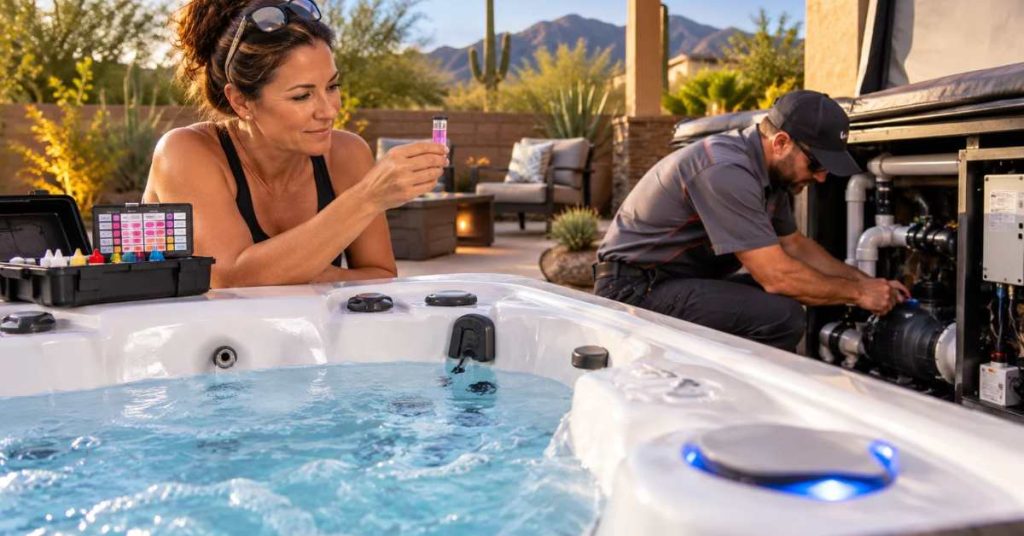
Owning a hot tub does not mean calling a technician every time the water needs attention.
A lot of routine spa maintenance is simple enough for homeowners to handle themselves.
Test the water. Rinse the filter. Check the water level. Clean the cover. Wipe down the shell.
Those tasks can become part of a normal weekly routine.
Other problems, though, should not turn into a weekend repair experiment.
Electrical issues, leaking equipment, pump problems, heater failures, and control-system errors usually make more sense to leave to a qualified professional.
For Tucson hot tub owners, the real challenge is knowing where that line is.
The desert climate adds a few extra considerations too. Dust can get into the water. High temperatures increase evaporation. Mineral-rich water can contribute to buildup over time.
So which jobs are worth doing yourself, and when is professional service worth paying for?
DIY: Test and Balance the Water
Water testing is one of the most useful maintenance skills an owner can learn.
You do not need a technician every time the chemistry changes.
Use the test method recommended for your spa and water-care system. Then adjust sanitizer, pH, alkalinity, and other levels according to the product and spa manufacturer’s directions.
Testing consistently helps you catch small chemistry issues before they turn into cloudy water or more difficult maintenance problems.
It also helps you learn what normal water looks and behaves like in your own spa.
DIY: Check the Water Level
This may seem almost too simple to mention, but it matters.
Tucson’s dry climate can cause noticeable evaporation, especially during hotter months.
Check the water level regularly.
If it drops too far, circulation and filtration may not work correctly.
Adding water is an easy DIY task.
If you suddenly find yourself adding much more water than usual, however, do not assume evaporation is the only explanation.
That may be the point where a leak needs to be investigated.
DIY: Rinse the Filter
Your filter collects dirt and debris from the water.
As that material builds up, water flow can be reduced.
Removing the filter and rinsing between the pleats is usually straightforward.
How often you need to do it depends on spa use, local conditions, and the manufacturer’s recommendations.
Tucson dust may mean the filter needs extra attention during windy periods or times of heavy use.
Check it regularly instead of waiting for water quality to decline.
DIY: Deep Clean the Filter
A quick rinse will not remove everything.
Body oils, lotions, and other buildup can remain trapped in the filter media.
When deeper cleaning is needed, use a hot tub filter cleaner that is appropriate for the cartridge and follow the product directions.
At some point, though, cleaning stops being the answer.
If the filter is damaged, badly worn, or no longer comes clean, replacement usually makes more sense than trying to keep extending its life.
DIY: Keep the Cover Clean
Your cover has a tough job in Tucson.
It deals with sun, heat, wind, and dust while also helping keep debris out of the water.
Brush off loose dirt and clean the surface with products made for the cover material.
Inspect it while you are there.
Watch for:
- Cracking
- Torn seams
- Broken straps
- Sagging
- Excessive weight
- Poor fit
A cover that has become waterlogged or badly damaged may need to be replaced rather than cleaned again.
DIY: Keep the Shell Clean
Most owners can handle routine shell care themselves.
Wipe away buildup around the waterline as needed.
During a drain and refill, clean the exposed shell with a non-abrasive, spa-safe product.
Avoid using random household cleaners.
They may leave residue or damage the surface.
Products designed for spa care are generally the better choice.
DIY: Pay Attention to Changes
One of the most useful maintenance habits costs nothing.
Notice what is different.
You use the spa often enough to know how it normally sounds and feels.
Pay attention if:
- Jets suddenly feel weaker
- A pump sounds different
- Heating takes longer than usual
- Error codes appear
- The water level drops quickly
- Water appears around the cabinet
- The spa shuts off unexpectedly
A small change does not always mean a major problem.
But noticing it early can make diagnosis much easier.
DIY: Keep Dirt Out Before It Reaches the Water
Preventive maintenance is usually easier than cleaning up dirty water later.
Keep the spa covered when it is not in use.
Brush dust off the cover before opening it.
Encourage users to rinse off sunscreen, lotions, sweat, and dirt before getting in.
Keep food away from the water.
Those small habits reduce the amount of work the filter and water-care system need to do.
When Is Professional Hot Tub Maintenance Worth Paying For?
Routine water care is one thing.
Troubleshooting equipment is another.
Once the problem moves beyond cleaning, testing, and basic owner maintenance, professional service often becomes the smarter option.
That is especially true when electricity, pumps, heaters, plumbing, or electronic controls are involved.
Professional: Electrical Problems
Hot tubs combine water and electrical equipment.
That alone is a good reason not to experiment.
If a breaker repeatedly trips, electrical components stop working, or you suspect a wiring problem, contact a qualified professional.
Do not keep resetting a breaker without finding out why it is tripping.
The breaker may be responding to a real equipment or electrical fault that needs proper diagnosis.
Professional: Pump and Motor Problems
Pumps keep water moving through the spa.
If a pump stops, becomes unusually noisy, leaks, or behaves differently, professional service is usually worth the cost.
Some problems may be relatively simple.
Others may involve seals, bearings, impellers, electrical components, or replacement parts.
A technician can diagnose the cause instead of turning the repair into a trial-and-error parts swap.
Professional: Heater Problems
If the spa stops heating or cannot maintain temperature, several components could be involved.
The problem might come from circulation, the heater, sensors, controls, or another part of the system.
Guessing can get expensive.
A qualified technician can work through the system and identify what is actually causing the problem.
Professional: Leaks You Cannot Easily Locate
A little water around the spa does not automatically mean a major leak.
People splash.
Water can run off the cover.
But a water level that keeps dropping deserves attention.
You can check the equipment area and visible plumbing for an obvious source.
If nothing stands out, professional leak diagnosis may save a great deal of time.
Some leaks are hidden inside plumbing or equipment areas that are difficult for an owner to access.
Professional: Recurring Water Problems
You balance the water.
A few days later, it looks wrong again.
You clean the filter.
The problem comes back.
You change the sanitizer routine.
Nothing seems to improve.
At that point, professional help may be worth it.
The problem could involve old water, circulation, filtration, buildup in the plumbing, incorrect product use, or another factor.
Instead of continuing to add chemicals without understanding the cause, it can be more effective to have the system evaluated.
Professional: Control Panel and Error Code Problems
Modern hot tubs can display diagnostic codes when something goes wrong.
Some have simple explanations in the owner’s manual.
Others point to sensors, circulation, heating, or control-system problems.
Read the manual first and follow any basic troubleshooting steps the manufacturer recommends.
If the code returns or the suggested steps do not solve the issue, schedule service.
Ignoring a diagnostic warning can allow a small problem to become a more expensive one.
What About Draining and Refilling?
Many hot tub owners can handle a drain and refill themselves.
The basic process is manageable when you follow the spa manufacturer’s directions.
But not everyone wants to spend the time doing it.
Draining, shell cleaning, filter maintenance, refilling, and rebalancing can take a while.
Professional service may be worth paying for if you would rather have the entire process handled for you.
It can also be useful for a new owner who wants to see what proper maintenance looks like before taking on more of the work independently.
Tucson Water Can Add Mineral Challenges
Tucson’s water can contribute to mineral buildup in a spa.
As water evaporates, the water itself leaves while dissolved minerals remain behind.
Then you add more water.
Over time, that can raise mineral concentration.
That is why repeatedly topping off the spa does not replace periodic draining and refilling.
Watch for buildup around jets, fittings, and other surfaces, and follow the water-care program recommended for your spa.
More chemicals are not always the answer.
Preventive Service Can Be Worth the Cost
Professional maintenance is not only for broken spas.
An occasional inspection may catch developing problems before they become more serious.
A technician might notice:
- A small leak
- A worn component
- An unusual pump sound
- Early corrosion
- A developing equipment issue
That can be especially useful for an older spa or one that gets heavy use.
Preventive service cannot guarantee that nothing will fail, but it can improve the chances of catching problems earlier.
DIY Maintenance Still Saves Money
Hiring a professional for some jobs does not mean giving up all owner maintenance.
For many Tucson hot tub owners, the best approach is a mix.
Handle the straightforward tasks yourself:
- Test the water
- Maintain water chemistry
- Check the water level
- Rinse filters
- Clean the cover
- Wipe the shell
- Watch for leaks and unusual operation
Then call a technician when the issue moves beyond normal maintenance.
That keeps ownership manageable without paying for service every week.
Sometimes Convenience Is Worth Paying For
Some owners simply do not want to manage every maintenance task themselves.
That is a reasonable choice too.
Maybe you travel frequently.
Perhaps the spa is at a second home.
Your schedule may already be full.
Or you bought the hot tub because you want to relax, not because you wanted another maintenance project.
In those situations, professional maintenance may be worth paying for simply because it keeps the spa ready to use.
Your time has value too.
New Owners May Benefit From Professional Help
The first few months of hot tub ownership come with a learning curve.
You are getting familiar with water chemistry, filters, covers, heating, and the normal sounds and behavior of the equipment.
Professional help early on can make ownership feel less confusing.
As you become more comfortable with the basics, you may decide to handle more of the routine maintenance yourself.
The Best Approach Is Usually a Mix of DIY and Professional Care
Hot tub maintenance does not have to be completely DIY or completely professional.
For most Tucson owners, the practical answer falls somewhere in the middle.
Learn the simple tasks.
Stay consistent with water care.
Keep the filter and cover clean.
Pay attention to changes.
Then know when to stop troubleshooting and call someone who works on spas every day.
Sunset Spas Tucson helps owners with hot tub maintenance, cleaning, filters, covers, water-care products, draining and refilling, and professional service.
The goal is not to pay someone for every small task.
It is to spend money where experience, proper tools, and accurate diagnosis can protect the spa and help keep a small problem from becoming a much larger one.
